Friday, 22 May 2020

Fairy Tale Friday--Gold-Tree and Silver-Tree (Scotland, 1894)

Hello and welcome to Fairy Tale Friday. Are you sitting comfortably? Good. Then I’ll begin.

This week we look at a tale from Scotland collected by Australian folklorist  Joseph Jacobs. Jacobs was fascinated by English fairy tales and folk tales and popularised tales like Goldilocks and the Three Bears and The Three Little Pigs. This story comes from Celtic Fairy Tales published in 1892.

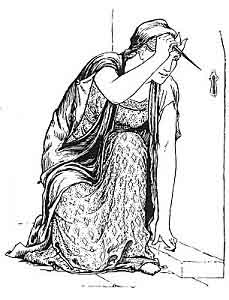
This tale is really interesting. Instead of a magic mirror we have a trout in a well who tells our mother Silver-Tree that her daughter Gold-Tree is more beautiful. Again, we have a real mother, not stepmother here. She says to her husband—the father of their child—that she must eat the child’s heart and liver, or she will never be well. Many men would be all upset saying “I am not killing my beautiful daughter just because you ask me to!” But this father just decides to marry his daughter off to someone far away so as not to confront his wife—the mother of their child—about this weird cannibalism she has planned. He then kills a goat and feeds it to her, and she is suddenly cured from her pretend illness.

The next year Silver-Tree asks the trout who is the most beautiful and finds out her daughter is alive, just married off to a faraway prince. She decides she would like to go and visit her daughter and her husband willingly put the long-ship in order and let her set sail. I despise weak fathers in these stories who do not fight tooth and nail for their daughters. Her daughter is wiser, for as soon as she recognises her father’s long-ship  and rightly declares, "my mother is coming, and she will kill me." She locks herself in a room but he mother convinces her to stick her pinkie through the keyhole for her to kiss it and you guessed it—poisons her by stabbing her finger.

Now here is where it gets freaky. Her husband comes home and finds her dead but because she is so beautiful he did not bury her at all, but he locked her in a room where nobody would get near her. Then he remarried and told his new wife not to go in the secret locked room because if you do, you’ll find out that it contains my dead first wife. Here we veer in Bluebeard territory, although he didn’t kill her, he still keeps her corpse in the house and tells his wife not to go in there. But she does go in there and finds the body of his first wife, which she revives by taking the poison stab out of her finger. Now, I don’t know why the man who loved her could not find something sticking out of her finger that didn’t belong but instead locked her dead body in a room in his house. Unlike Bluebeard, he is delighted that Gold-Tree is alive again and declares to his second wife in a surprising twist of polygamy, "Oh! indeed you shall not go away, but I shall have both of you."

Remarks by Joseph Jacobs: It is unlikely, I should say impossible, that this tale, with the incident of the dormant heroine, should have arisen independently in the Highlands; it is not likely an importation from abroad. Yet in it occurs a most "primitive" incident, the bigamous household of the hero.... On the "survival" method of investigation this would possibly be used as evidence for polygamy in the Highlands. Yet if, as is probably, the story came from abroad, this trait may have come with it, and only implies polygamy in the original home of the tale.

Then her mother upon finding Gold-Tree alive again, boards a long-ship from home and comes to her with the flimsy premise of bringing her daughter a precious drink. Which is fooling no one, I assure you. The second wife manages to outwit the evil mother and kill her (Hoorah!) and the prince and his two wives were long alive after this, pleased and peaceful.

Yeah. I bet they did.

 Celtic Fairy Tales: Gold-Tree and Silver-Tree

Thursday, 21 May 2020

How They Spent the Night in The Emerald City--Oz pages 25 and 26

Hello lovelies! The next illustrations really are all about the story. I am just so in love with Baum’s writing. His little attention to details and character development just melt my heart.

I wanted the art to mainly be about the description of each of our travellers and how they spent their first night in Oz. I love the bit about everyone having to wipe their feet on the green mat. The story tells us:

So they passed through the Palace Gates and were led into a big room with a green carpet and lovely green furniture set with emeralds. The soldier made them all wipe their feet upon a green mat before entering this room, and when they were seated, he said politely:

"Please make yourselves comfortable while I go to the door of the Throne Room and tell Oz you are here."

They had to wait a long time before the soldier returned. When, at last, he came back, Dorothy asked:

"Have you seen Oz?"

"Oh, no," returned the soldier; "I have never seen him. But I spoke to him as he sat behind his screen and gave him your message. He said he will grant you an audience, if you so desire; but each one of you must enter his presence alone, and he will admit but one each day. Therefore, as you must remain in the Palace for several days, I will have you shown to rooms where you may rest in comfort after your journey."

Note: This is different form the film where they all got to go in together.

"Thank you," replied the girl; "that is very kind of Oz."

The soldier now blew upon a green whistle, and at once a young girl, dressed in a pretty green silk gown, entered the room. She had lovely green hair and green eyes, and she bowed low before Dorothy as she said, "Follow me and I will show you your room."

So Dorothy said good-bye to all her friends except Toto  and taking the dog in her arms followed the green girl through seven passages and up three flights of stairs until they came to a room at the front of the Palace. It was the sweetest little room in the world, with a soft comfortable bed that had sheets of green silk and a green velvet counterpane. There was a tiny fountain in the middle of the room, that shot a spray of green perfume into the air, to fall back into a beautifully carved green marble basin. Beautiful green flowers stood in the windows, and there was a shelf with a row of little green books. When Dorothy had time to open these books she found them full of queer green pictures that made her laugh, they were so funny.

In a wardrobe were many green dresses, made of silk and satin and velvet; and all of them fitted Dorothy exactly.


This is the first of my illustrations. I used the quote about all the dresses and sewed a tiny dress out of green velveteen with a green ribbon sash and constructed a teeny metal hanger (that poked the crap out of my thumb) which I covered in black electrical tape to prevent other accidents. I also gave an iridescent wash of pink over Dorothy's words. 

"Make yourself perfectly at home," said the green girl, "and if you wish for anything ring the bell. Oz will send for you tomorrow morning."

She left Dorothy alone and went back to the others. These she also led to rooms, and each one of them found himself lodged in a very pleasant part of the Palace. Of course this politeness was wasted on the Scarecrow; for when he found himself alone in his room he stood stupidly in one spot, just within the doorway, to wait till morning. It would not rest him to lie down, and he could not close his eyes; so he remained all night staring at a little spider which was weaving its web in a corner of the room, just as if it were not one of the most wonderful rooms in the world.

This quote is the bottom half of the first page. I used the quote about him staring at the spider and used my spiderweb and spider stamp (of course someone named Spidergrrl has a spider stamp!) to be his illustration.  I also gave an iridescent wash of blue over the Scarecrow's words. 


The Tin Woodman lay down on his bed from force of habit, for he remembered when he was made of flesh; but not being able to sleep, he passed the night moving his joints up and down to make sure they kept in good working order.

This is the top of my second page of illustration. I used the silver wrapping paper that I used to make him several pages back as well as the stencils and glued on his lower body exercising his joints. I also gave an iridescent wash of silver over the Tin Woodman's words. 

The Lion would have preferred a bed of dried leaves in the forest, and did not like being shut up in a room; but he had too much sense to let this worry him, so he sprang upon the bed and rolled himself up like a cat and purred himself asleep in a minute.

For this part of the illustration I sewed some green felt leaves in a pile. I wanted most of the page to be green as they see everything in green but decided to leave the Tin Woodman silver. I also thought to have two cloth and two paper illustrations for this double page spread.  I also gave an iridescent wash of orange over the Lion's words. 

The next morning, after breakfast, the green maiden came to fetch Dorothy, and she dressed her in one of the prettiest gowns, made of green brocaded satin. Dorothy put on a green silk apron and tied a green ribbon around Toto's neck, and they started for the Throne Room of the Great Oz.

Note: This description of the green dress and green ribbon for Toto will be important in a few chapters.

Here they are side by side. I really like what I did with the two shades of green paint in triangles. It reminds me of a harlequinade.


Stay tuned for the next illustration where our first two friends meet very different Wizards.


Tuesday, 19 May 2020

The Emerald City and Why It Is Green--Oz pages 23 and 24

Hello lovelies! I know I keep saying this is my favourite part of the book, but it really is. This part is going to blow your tiny mind.

Let’s see what our group of travellers is up to:

The road was smooth and well paved, now, and the country about was beautiful, so that the travellers rejoiced in leaving the forest far behind, and with it the many dangers they had met in its gloomy shades. Once more they could see fences built beside the road; but these were painted green, and when they came to a small house, in which a farmer evidently lived, that also was painted green. They passed by several of these houses during the afternoon, and sometimes people came to the doors and looked at them as if they would like to ask questions; but no one came near them nor spoke to them because of the great Lion, of which they were very much afraid. The people were all dressed in clothing of a lovely emerald-green colour and wore peaked hats like those of the Munchkins.

"Yes," answered the Scarecrow. "Everything is green here, while in the country of the Munchkins blue was the favourite colour. But the people do not seem to be as friendly as the Munchkins, and I'm afraid we shall be unable to find a place to pass the night."

"I should like something to eat besides fruit," said the girl, "and I'm sure Toto is nearly starved. Let us stop at the next house and talk to the people."

So, when they came to a good-sized farmhouse, Dorothy walked boldly up to the door and knocked.

A woman opened it just far enough to look out, and said, "What do you want, child, and why is that great Lion with you?"

"We wish to pass the night with you, if you will allow us," answered Dorothy; "and the Lion is my friend and comrade and would not hurt you for the world."

"Is he tame?" asked the woman, opening the door a little wider.

"Oh, yes," said the girl, "and he is a great coward, too. He will be more afraid of you than you are of him."

"Well," said the woman, after thinking it over and taking another peep at the Lion, "if that is the case you may come in, and I will give you some supper and a place to sleep."

Can I just say how much I love the description below of what they ate (nice white bread) and how they rested? I always loved that Baum put in these important details.

The woman now called to them that supper was ready, so they gathered around the table and Dorothy ate some delicious porridge and a dish of scrambled eggs and a plate of nice white bread and enjoyed her meal. The Lion ate some of the porridge, but did not care for it, saying it was made from oats and oats were food for horses, not for lions. The Scarecrow and the Tin Woodman ate nothing at all. Toto ate a little of everything and was glad to get a good supper again.

The woman now gave Dorothy a bed to sleep in, and Toto lay down beside her, while the Lion guarded the door of her room so she might not be disturbed. The Scarecrow and the Tin Woodman stood up in a corner and kept quiet all night, although of course they could not sleep.

I have decided to illustrate their view of seeing the Emerald City up on a hill at the end of the yellow brick road. The text describes the emeralds as glittering so bright in the sun  that even the painted eyes of the Scarecrow were dazzled by their brilliancy. I cannot love that sentence enough. I decided to use my glitter card and some stick on jewels to make the Emerald City really stand out on the top of a hill.


The next morning, as soon as the sun was up, they started on their way, and soon saw a beautiful green glow in the sky just before them.

"That must be the Emerald City," said Dorothy.

As they walked on, the green glow became brighter and brighter, and it seemed that at last they were nearing the end of their travels. Yet it was afternoon before they came to the great wall that surrounded the City. It was high and thick and of a bright green colour.

In front of them, and at the end of the road of yellow brick, was a big gate, all studded with emeralds that glittered so in the sun that even the painted eyes of the Scarecrow were dazzled by their brilliancy.

So what about the second picture? Well be prepared to have your mind blown.

There was a bell beside the gate, and Dorothy pushed the button and heard a silvery tinkle sound within. Then the big gate swung slowly open, and they all passed through and found themselves in a high arched room, the walls of which glistened with countless emeralds.

Before them stood a little man about the same size as the Munchkins. He was clothed all in green, from his head to his feet, and even his skin was of a greenish tint. At his side was a large green box.

When he saw Dorothy and her companions the man asked, "What do you wish in the Emerald City?"

"We came here to see the Great Oz," said Dorothy.

The man was so surprised at this answer that he sat down to think it over.

"It has been many years since anyone asked me to see Oz," he said, shaking his head in perplexity. "He is powerful and terrible, and if you come on an idle or foolish errand to bother the wise reflections of the Great Wizard, he might be angry and destroy you all in an instant."

"But it is not a foolish errand, nor an idle one," replied the Scarecrow; "it is important. And we have been told that Oz is a good Wizard."

"So he is," said the green man, "and he rules the Emerald City wisely and well. But to those who are not honest, or who approach him from curiosity, he is most terrible, and few have ever dared ask to see his face. I am the Guardian of the Gates, and since you demand to see the Great Oz I must take you to his Palace. But first you must put on the spectacles."

Put on the spectacles? Say what?

"Why?" asked Dorothy.

"Because if you did not wear spectacles the brightness and glory of the Emerald City would blind you. Even those who live in the City must wear spectacles night and day. They are all locked on, for Oz so ordered it when the City was first built, and I have the only key that will unlock them."


The. Emerald. City. Is. Green. Because. You. Are. Wearing. Green. Spectacles. *Head explodes*

This is my second illustration. I made the box and a pair of sparkly green-tinted spectacles (I used green acetate that I have for just this purpose in case someone needs green-tinted spectacles). I also attached a real brass key that I have left over from a pack of three (I used one of them in a Christmas ornament a few years back) with some green ribbon.

He opened the big box, and Dorothy saw that it was filled with spectacles of every size and shape. All of them had green glasses in them. The Guardian of the Gates found a pair that would just fit Dorothy and put them over her eyes. There were two golden bands fastened to them that passed around the back of her head, where they were locked together by a little key that was at the end of a chain the Guardian of the Gates wore around his neck. When they were on, Dorothy could not take them off had she wished, but of course she did not wish to be blinded by the glare of the Emerald City, so she said nothing.

Then the green man fitted spectacles for the Scarecrow and the Tin Woodman and the Lion, and even on little Toto; and all were locked fast with the key.

Me in my messy art room wearing my green-tinted spectacles.

Then the Guardian of the Gates put on his own glasses and told them he was ready to show them to the Palace. Taking a big golden key from a peg on the wall, he opened another gate, and they all followed him through the portal into the streets of the Emerald City.

Even with eyes protected by the green spectacles, Dorothy and her friends were at first dazzled by the brilliancy of the wonderful City. The streets were lined with beautiful houses all built of green marble and studded everywhere with sparkling emeralds. They walked over a pavement of the same green marble, and where the blocks were joined together were rows of emeralds, set closely, and glittering in the brightness of the sun. The windowpanes were of green glass; even the sky above the City had a green tint, and the rays of the sun were green.

There were many people--men, women, and children--walking about, and these were all dressed in green clothes and had greenish skins. They looked at Dorothy and her strangely assorted company with wondering eyes, and the children all ran away and hid behind their mothers when they saw the Lion; but no one spoke to them. Many shops stood in the street, and Dorothy saw that everything in them was green. Green candy and green popcorn were offered for sale, as well as green shoes, green hats, and green clothes of all sorts. At one place a man was selling green lemonade, and when the children bought it Dorothy could see that they paid for it with green pennies.

There seemed to be no horses nor animals of any kind; the men carried things around in little green carts, which they pushed before them. Everyone seemed happy and contented and prosperous.

Isn’t that fantastic???? The only quibble I have is that why is the Guardian of the Gate’s skin a greenish tinge BEFORE they put on their glasses?  It says: He was clothed all in green, from his head to his feet, and even his skin was of a greenish tint. Now, it makes sense once they are all spectacled up that there were many people--men, women, and children--walking about, and these were all dressed in green clothes and had greenish skins. Perhaps all inhabitants of the Emerald City already have green tinted skin. Later Oz books by former Oz illustrator John R Neil had everyone have skin the same colour as their respected country (as well as the grass and anything else…so Munchkins were blue people, wearing blue clothes, standing on blue grass and eating blue food inside blue houses etc etc.)

Here they are side by side.


The next illustrations tell us about spending the night in Oz.


Monday, 18 May 2020

The Queen of the Field Mice--Oz pages 21 and 22

Hello lovelies! Today I am sharing one of my favourite parts of the book. I know I say that a lot, but this is really true. The Queen of the Field Mice beats asbestos snow hands down (in more ways than one.)

Our friends have no way to carry the Lion out of the deadly poppy field and so are having to leave him there. As they walk out, this happens. Can I just say the line which worked beautifully on hinges makes me smile every time.

The Tin Woodman was about to reply when he heard a low growl and turning his head (which worked beautifully on hinges) he saw a strange beast come bounding over the grass toward them. It was, indeed, a great yellow Wildcat, and the Woodman thought it must be chasing something, for its ears were lying close to its head and its mouth was wide open, showing two rows of ugly teeth, while its red eyes glowed like balls of fire. As it came nearer the Tin Woodman saw that running before the beast was a little  field mouse, and although he had no heart he knew it was wrong for the Wildcat to try to kill such a pretty, harmless creature.

So the Woodman raised his axe, and as the Wildcat ran by, he gave it a quick blow that cut the beast's head clean off from its body, and it rolled over at his feet in two pieces.

The field mouse, now that it was freed from its enemy, stopped short; and coming slowly up to the Woodman it said, in a squeaky little voice:

"Oh, thank you! Thank you ever so much for saving my life."

"Don't speak of it, I beg of you," replied the Woodman. "I have no heart, you know, so I am careful to help all those who may need a friend, even if it happens to be only a mouse."

"Only a mouse!" cried the little animal, indignantly. "Why, I am a Queen--the Queen of all the Field Mice!"

"Oh, indeed," said the Woodman, making a bow.

"Therefore you have done a great deed, as well as a brave one, in saving my life," added the Queen.

At that moment several mice were seen running up as fast as their little legs could carry them, and when they saw their Queen they exclaimed:

"Oh, your Majesty, we thought you would be killed! How did you manage to escape the great Wildcat?" They all bowed so low to the little Queen that they almost stood upon their heads.

"This funny tin man," she answered, "killed the Wildcat and saved my life. So hereafter you must all serve him and obey his slightest wish."


I love this scene and it is the one I have chosen to represent in my altered book. I used some Eric Carle paper for the background in a nice shade of mousy-grey and pink and then sewed the little Queen out of felt. I love her little tubby tummy and indignant pose with her hands on her hips. I made her tail out of pink ribbon (even though the tail of a field mouse would have been more beige/grey not pink) and worked out how to gracefully loop it round and have her hold it.  I even manged to make her some tiny whiskers, but you may have to enlarge the photo to see them.

So how did the Queen of the Field Mice help save the Lion? This is the most amazing bit. It was so amazing in fact, that I felt it needed a pocket with the story in it so that is precisely what I have done.


I used a variation of the original WW Denslow illustration of all the little mice that I added more mice to and printed on parchment paper as the background (see the little Queen sitting in the right corner?) and then added a grey pocket with a gold crown and the story of their dramatic rescue on pink paper with a lavender ribbon to match the purple jewel in her crown.

Read here for the amazing rescue tale involving thousands of mice who all happen to be able to get bits of string. If you suspend your disbelief about “where do all these mice gets string?” then this is a fantastic tale.

"Is there anything we can do," it asked, "to repay you for saving the life of our Queen?"

"Nothing that I know of," answered the Woodman; but the Scarecrow, who had been trying to think, but could not because his head was stuffed with straw, said, quickly, "Oh, yes; you can save our friend, the Cowardly Lion, who is asleep in the poppy bed."

"A Lion!" cried the little Queen. "Why, he would eat us all up."

"Oh, no," declared the Scarecrow; "this Lion is a coward."

"Really?" asked the Mouse.

"He says so himself," answered the Scarecrow, "and he would never hurt anyone who is our friend. If you will help us to save him, I promise that he shall treat you all with kindness."

"Very well," said the Queen, "we trust you. But what shall we do?"

"Are there many of these mice which call you Queen and are willing to obey you?"

"Oh, yes; there are thousands," she replied.

"Then send for them all to come here as soon as possible and let each one bring a long piece of string."

The Queen turned to the mice that attended her and told them to go at once and get all her people. As soon as they heard her orders they ran away in every direction as fast as possible.

"Now," said the Scarecrow to the Tin Woodman, "you must go to those trees by the riverside and make a truck that will carry the Lion."

So the Woodman went at once to the trees and began to work; and he soon made a truck out of the limbs of trees, from which he chopped away all the leaves and branches. He fastened it together with wooden pegs and made the four wheels out of short pieces of a big tree trunk. So fast and so well did he work that by the time the mice began to arrive the truck was all ready for them.

They came from all directions, and there were thousands of them: big mice and little mice and middle-sized mice; and each one brought a piece of string in his mouth. It was about this time that Dorothy woke from her long sleep and opened her eyes. She was greatly astonished to find herself lying upon the grass, with thousands of mice standing around and looking at her timidly. But the Scarecrow told her about everything, and turning to the dignified little Mouse, he said:

"Permit me to introduce to you her Majesty, the Queen."

Dorothy nodded gravely and the Queen made a curtsy, after which she became quite friendly with the little girl.

The Scarecrow and the Woodman now began to fasten the mice to the truck, using the strings they had brought. One end of a string was tied around the neck of each mouse and the other end to the truck. Of course the truck was a thousand times bigger than any of the mice who were to draw it; but when all the mice had been harnessed, they were able to pull it quite easily. Even the Scarecrow and the Tin Woodman could sit on it and were drawn swiftly by their queer little horses to the place where the Lion lay asleep.

After a great deal of hard work, for the Lion was heavy, they managed to get him up on the truck. Then the Queen hurriedly gave her people the order to start, for she feared if the mice stayed among the poppies too long, they also would fall asleep.

At first the little creatures, many though they were, could hardly stir the heavily loaded truck; but the Woodman and the Scarecrow both pushed from behind, and they got along better. Soon they rolled the Lion out of the poppy bed to the green fields, where he could breathe the sweet, fresh air again, instead of the poisonous scent of the flowers.

Dorothy came to meet them and thanked the little mice warmly for saving her companion from death. She had grown so fond of the big Lion she was glad he had been rescued.

Then the mice were unharnessed from the truck and scampered away through the grass to their homes. The Queen of the Mice was the last to leave.

"If ever you need us again," she said, "come out into the field and call, and we shall hear you and come to your assistance. Good-bye!"

Isn’t that lovely? Here they are side by side.


The next illustration we will arrive in the Emerald City.


Friday, 15 May 2020

The Deadly Poppy Field--Oz pages 19 and 20

Hello lovelies! Today begins one of the parts that is both book and film related—the deadly poppy field. In the film it is set up to be a trap by the Wicked Witch of the West to ensnare them and in the film, they are saved by Glinda the good witch who makes it snow. Which incidentally (bit of film trivia for you) was made of asbestos. ASBESTOS. The snow they used was asbestos—and this was AFTER knowing for several years that asbestos caused cancer. The magic of Hollywood.

Here, the poppy field is just another part of Oz which is full of strange things, both wonderful and wild. I have decided as the field of poppies is so vast that it should be a two page spread.. The book states:

They walked along listening to the singing of the brightly coloured birds and looking at the lovely flowers which now became so thick that the ground was carpeted with them. There were big yellow and white and blue and purple blossoms, besides great clusters of scarlet poppies, which were so brilliant in colour they almost dazzled Dorothy's eyes.

"Aren't they beautiful?" the girl asked, as she breathed in the spicy scent of the bright flowers.

"I suppose so," answered the Scarecrow. "When I have brains, I shall probably like them better."

"If I only had a heart, I should love them," added the Tin Woodman.

"I always did like flowers," said the Lion. "They seem so helpless and frail. But there are none in the forest so bright as these."


I decided to paint the background with just a green watercolour wash. I wanted to use tissue paper to make the poppies and my test pieces all showed that green paint muddied the colour of the red poppies. I thought about and tested poppies that I cut from tissue, but ultimately decided to go with torn red tissue. I loved that this gave them a wild and ragged look. That way every poppy would be different. I also freehandedly cut (whilst watching an exciting episode of Doctor Who) all the black centres. I glued them down with just barely a blob of glue in the middle so that the petals would be able to have movement and then then glued a smaller torn piece in a roughly circular shape in the centre. I let them completely dry and then glued the centres on.

Interesting bit of trivia:  In 1902 (2 years after the book was published) Baum turned The Wonderful Wizard of Oz into a musical extravaganza. It had a series of shapely chorus girls with big red flower headdresses as the poppy field and a cow named Imogene instead of Toto (just because it is easier to have two actors playing a pantomime cow than to have a real unpredictable dog). Also this is where MGM got the idea for snow waking them up from the deadly poppies. They probably used asbestos in 1902 as well, but they didn’t know any better. They did by 1939 though, so there is no excuse.

So how did they escape:

They now came upon more and more of the big scarlet poppies, and fewer and fewer of the other flowers; and soon they found themselves in the midst of a great meadow of poppies. Now it is well known that when there are many of these flowers together their odour is so powerful that anyone who breathes it falls asleep, and if the sleeper is not carried away from the scent of the flowers, he sleeps on and on forever. But Dorothy did not know this, nor could she get away from the bright red flowers that were everywhere about; so presently her eyes grew heavy and she felt she must sit down to rest and to sleep.

But the Tin Woodman would not let her do this.

"We must hurry and get back to the road of yellow brick before dark," he said; and the Scarecrow agreed with him. So they kept walking until Dorothy could stand no longer. Her eyes closed in spite of herself and she forgot where she was and fell among the poppies, fast asleep.

"What shall we do?" asked the Tin Woodman.

"If we leave her here she will die," said the Lion. "The smell of the flowers is killing us all. I myself can scarcely keep my eyes open, and the dog is asleep already."

It was true; Toto had fallen down beside his little mistress. But the Scarecrow and the Tin Woodman, not being made of flesh, were not troubled by the scent of the flowers.

"Run fast," said the Scarecrow to the Lion, "and get out of this deadly flower bed as soon as you can. We will bring the little girl with us, but if you should fall asleep you are too big to be carried."

So the Lion aroused himself and bounded forward as fast as he could go. In a moment he was out of sight.

"Let us make a chair with our hands and carry her," said the Scarecrow. So they picked up Toto and put the dog in Dorothy's lap, and then they made a chair with their hands for the seat and their arms for the arms and carried the sleeping girl between them through the flowers.

On and on they walked, and it seemed that the great carpet of deadly flowers that surrounded them would never end. They followed the bend of the river, and at last came upon their friend the Lion, lying fast asleep among the poppies. The flowers had been too strong for the huge beast and he had given up at last and fallen only a short distance from the end of the poppy bed, where the sweet grass spread in beautiful green fields before them.

"We can do nothing for him," said the Tin Woodman, sadly; "for he is much too heavy to lift. We must leave him here to sleep on forever, and perhaps he will dream that he has found courage at last."

"I'm sorry," said the Scarecrow. "The Lion was a very good comrade for one so cowardly. But let us go on."

They carried the sleeping girl to a pretty spot beside the river, far enough from the poppy field to prevent her breathing any more of the poison of the flowers, and here they laid her gently on the soft grass and waited for the fresh breeze to waken her.

So how did they help the Lion escape if there was no asbestos snow, I hear you cry? Why, with the help of the Queen of the Field Mice of course! Stay tuned!!!!


Fairy Tale Friday--The Crystal Casket (Italy, 1885)

Hello and welcome to Fairy Tale Friday. Are you sitting comfortably? Good. Then I’ll begin.

This week we look at a tale from 1885 collected by American folklorist Thomas Frederick Crane. Crane was a librarian for newly founded Cornell University and  went on to become a student of languages where he taught French, Italian, Spanish, and medieval literature. He was also one of the founders of the Journal of American Folklore. This story comes from his collection Italian Popular Tales.

This tale begins with an infuriating statement There was once a widower who had a daughter. This daughter was between ten and twelve years old. Between ten and twelve years old is eleven. She was eleven years old. Just say that for Frith’s sake!

In last week’s story, it was the father who mistakenly thought that the teacher would make a good wife because she sent her kind regards to him, but in this tale it is the teacher who actively pursues the father by saying to the eleven year old girl, "Ask your father if he would like me for a wife." The father is not interested. He even tells his eleven year old daughter that there will be great troubles for her if her remarries, but she is insistent because she likes her teacher.  So in many ways, she brings all of her troubles onto herself.

In an unusual twist the stepmother forces her out into a balcony over a raging river to water a pot of basil (which made me think of Isabella and the Pot of Basil where the skull of her murdered sweetheart is concealed under the basil) and an eagle takes her away to be raised in crystal palace by fairies who would care for her.

Now the stepmother reveals that she hasn’t seen the daughter in ten days. Ten days! Her father is not dead leaving her alone with a terrible stepmother. Has he not noticed that his eleven year old daughter has been missing for ten days? Where is he in all of this? Did he think to himself, “Well I did say remarrying will cause you great trouble. I wash my hands of you.” Who knows. Perhaps he was away on business. That would explain why he hadn’t noticed  his own daughter was missing for ten days.

When the eagle reveals that Ermellina (yes, that really is her name) is being cared for by fairies in a crystal palace the stepmother goes ballistic. She hires a witch from the city to take Ermellina out. The witch disguises herself as a trusted servant from her house and brings a basket of poisoned sweetmeats supposedly from the girl’s father. Now, this I found quite clever. I never really bought the whole “disguised as a series of slightly different peddler women” trope from other Snow White tales. They all make Snow White out to be a bit thick when she keeps getting tempted by her vanity and desire for fine things (ribbons, a comb etc) by someone who vaguely resembles her stepmother. But here—a trusted servant and her father make it more plausible that she would open the door.

The witch tries again this time in the disguise of someone else that Ermellina knew—the family tailoress. Despite having been warned severely by the Chief of the Fairies not to open the door again, we get a sense of that vanity (or perhaps stupidity) of other Snow White stories as she allows the tailoress inside the house. At first she is reluctant saying, “No, I have been deceived before” but then the witch says "But I am not the old woman," replied the tailoress, "you know me, for I have always made your dresses." Did Ermellina say “Hang on a minute! How do you know the other person who deceived me was an old woman? Hmmm?” No. No she does not. So she gets buttoned into a poison dress.

The Chief of the Fairies refuses to help her saying she had two chances and disobeyed both times, so she doesn’t deserve our help.

When Ermellina’s body in the diamond studded crystal casket is found by the King he brings her home and we get a strange whiff of that uncomfortable necrophilia again.

"Mother, I went hunting, but I have found a wife."

"But what is it? A doll? A dead woman?"

"Mother," replied her son, "don't trouble yourself about what it is, it is my wife."

The story ends (after some neglect of poor dead Ermellina’s body by the King’s mother) with a wedding where they become man and wife. I cannot begin to tell you how I hate that phrase implying that a man stays a man after marriage, but a woman becomes a wife.

Basil Dolce Fresca | All-America Selections

.

The Crystal Casket source


There was once a widower who had a daughter. This daughter was between ten and twelve years old. Her father sent her to school, and as she was all alone in the world commended her always to her teacher. Now, the teacher, seeing that the child had no mother, fell in love with the father, and kept saying to the girl, "Ask your father if he would like me for a wife."

This she said to her every day, and at last the girl said, "Papa, the school-mistress is always asking me if you will marry her."

The father said, "Eh! my daughter, if I take another wife, you will have great troubles."

But the girl persisted, and finally the father was persuaded to go one evening to the school-mistress' house. When she saw him she was well pleased, and they settled the marriage in a few days. Poor child! How bitterly she had to repent having found a stepmother so ungrateful and cruel to her! She sent her every day out on a terrace to water a pot of basil, and it was so dangerous that if she fell, she would go into a large river.

One day there came by a large eagle, and said to her, "What are you doing here?" She was weeping because she saw how great the danger was of falling into the stream. The eagle said to her, "Get on my back, and I will carry you away, and you will be happier than with your new mamma."

After a long journey they reached a great plain, where they found a beautiful palace all of crystal; the eagle knocked at the door and said, "Open, my ladies, open! for I have brought you a pretty girl." When the people in the palace opened the door, and saw that lovely girl, they were amazed, and kissed and caressed her. Meanwhile the door was closed, and they remained peaceful and contended.

Let us return to the eagle, who thought she was doing a spite to the stepmother. One day the eagle flew away to the terrace where the stepmother was watering the basil. "Where is your daughter?" asked the eagle.

"Eh!" she replied, "perhaps she fell from this terrace and went into the river; I have not heard from her in ten days."

The eagle answered, "What a fool you are! I carried her away; seeing that you treated her so harshly I carried her away to my fairies, and she is very well." Then the eagle flew away.

The stepmother, filled with rage and jealousy, called a witch from the city, and said to her, "You see my daughter is alive, and is in the house of some fairies of an eagle which often comes upon my terrace; now you must do me the favour to find some way to kill this stepdaughter of mine, for I am afraid that someday or other she will return, and my husband, discovering this matter, will certainly kill me."

The witch answered, "Oh, you need not be afraid of that; leave it to me."

What did the witch do? She had made a little basketful of sweetmeats, in which she put a charm; then she wrote a letter, pretending that it was her father, who, having learned where she was, wished to make her this present, and the letter pretended that her father was so glad to hear that she was with the fairies.

Let us leave the witch who is arranging all this deception and return to Ermellina (for so the young girl was named). The fairies had said to her, "See, Ermellina, we are going away, and shall be absent four days; now in this time take good care not to open the door to anyone, for some treachery is being prepared for you by your stepmother."

She promised to open the door to no one: "Do not be anxious, I am well off, and my stepmother has nothing to do with me."

But it was not so. The fairies went away, and the next day when Ermellina was alone, she heard a knocking at the door, and said to herself, "Knock away! I don't open to anyone."

But meanwhile the blows redoubled, and curiosity forced her to look out of the window. What did she see? She saw one the servant girls of her own home (for the witch had disguised herself as one of her father's servants). "O my dear Ermellina," she said, "your father is shedding tears of sorrow for you, because he really believed you were dead, but the eagle which carried you off came and told him the good news that you were here with the fairies. Meanwhile your father, not knowing what civility to show you, for he understands very well that you are in need of nothing, has thought to send you this little basket of sweetmeats."

Ermellina had not yet opened the door; the servant begged her to come down and take the basket and the letter, but she said, "No, I wish nothing!" but finally, since women, and especially young girls, are fond of sweetmeats, she descended and opened the door. When the witch had given her the basket, she said, "Eat this," and broke off for her a piece of the sweetmeats which she had poisoned. When Ermellina took the first mouthful the old woman disappeared. Ermellina had scarcely time to close the door, when she fell down on the stairs.

When the fairies returned, they knocked at the door, but no one opened it for them; then they perceived that there had been some treachery and began to weep. Then the chief of the fairies said, "We must break open the door," and so they did, and saw Ermellina dead on the stairs.

Her other friends who loved her so dearly begged the chief of the fairies to bring her to life, but she would not, "for," she said, "she has disobeyed me." But one and the other asked her until she consented; she opened Ermellina's mouth, took out a piece of the sweetmeat which she had not yet swallowed, raised her up, and Ermellina came to life again.

We can imagine what a pleasure it was for her friends; but the chief of the fairies reproved her for her disobedience, and she promised not to do so again.

Once more the fairies were obliged to depart. Their chief said, "Remember, Ermellina: The first time I cured you, but the second I will have nothing to do with you."

Ermellina said they need not worry, that she would not open to anyone. But it was not so; for the eagle, thinking to increase her stepmother's anger, told her again that Ermellina was alive. The stepmother denied it all to the eagle, but she summoned a new the witch, and told her that her stepdaughter was still alive, saying, "Either you will really kill her, or I will be avenged on you."

The old woman, finding herself caught, told her to buy a very handsome dress, one of the handsomest she could find, and transformed herself into a tailoress belonging to the family, took the dress, departed, went to poor Ermellina, knocked at the door and said, "Open, open, for I am your tailoress."

Ermellina looked out of the window and saw her tailoress; and was, in truth, a little confused (indeed, anyone would have been so).

The tailoress said, "Come down, I must fit a dress on you."

She replied, "No, no; for I have been deceived once."

"But I am not the old woman," replied the tailoress, "you know me, for I have always made your dresses."

Poor Ermellina was persuaded and descended the stairs; the tailoress took to flight while Ermellina was yet buttoning up the dress and disappeared. Ermellina closed the door and was mounting the stairs; but it was not permitted her to go up, for she fell down dead.

Let us return to the fairies, who came home and knocked at the door; but what good did it do to knock! There was no longer anyone there. They began to weep. The chief of the fairies said, "I told you that she would betray me again; but now I will have nothing more to do with her."

So they broke open the door and saw the poor girl with the beautiful dress on; but she was dead. They all wept, because they really loved her. But there was nothing to do; the chief struck her enchanted wand, and commanded a beautiful rich casket all covered with diamonds and other precious stones to appear; then the others made a beautiful garland of flowers and gold, put it on the young girl, and then laid her in the casket, which was so rich and beautiful that it was marvellous to behold. Then the old fairy struck her wand as usual and commanded a handsome horse, the like of which not even the king possessed. Then they took the casket, put it on the horse's back, and led him into the public square of the city, and the chief of the fairies said, "Go, and do not stop until you find someone who says to you, 'Stop, for pity's sake, for I have lost my horse for you.'"

Now let us leave the afflicted fairies, and turn our attention to the horse, which ran away at full speed. Who happened to pass at that moment? The son of a king (the name of this king is not known); and saw this horse with that wonder on its back. Then the king began to spur his horse, and rode him so hard that he killed him, and had to leave him dead in the road; but the king kept running after the other horse. The poor king could endure it no longer; he saw himself lost, and exclaimed, "Stop, for pity's sake, for I have lost my horse for you!"

Then the horse stopped (for those were the words). When the king saw that beautiful girl dead in the casket, he thought no more about his own horse, but took the other to the city. The king's mother knew that her son had gone hunting; when she saw him returning with this loaded horse, she did not know what to think. The son had no father, wherefore he was all powerful. He reached the palace, had the horse unloaded, and the casket carried to his chamber; then he called his mother and said, "Mother, I went hunting, but I have found a wife."

"But what is it? A doll? A dead woman?"

"Mother," replied her son, "don't trouble yourself about what it is, it is my wife."

His mother began to laugh and withdrew to her own room (what could she do, poor mother?).

Now this poor king no longer went hunting, took no diversion, did not even go to the table, but ate in his own room. By a fatality it happened that war was declared against him, and he was obliged to depart. He called his mother, and said, "Mother, I wish two careful chambermaids, whose business it shall be to guard this casket; for if on my return I find that anything has happened to my casket, I shall have the chambermaids killed."

His mother, who loved him, said, "Go, my son, fear nothing, for I myself will watch over your casket."

He wept several days at being obliged to abandon this treasure of his, but there was no help for it, he had to go. After his departure he did nothing but commend his wife (so he called her) to his mother in his letters.

Let us return to the mother, who no longer thought about the matter, not even to have the casket dusted; but all at once there came a letter which informed her that the king had been victorious, and should return to his palace in a few days. The mother called the chambermaids, and said to them, "Girls, we are ruined."

They replied, "Why, Highness?"

"Because my son will be back in a few days, and how have we taken care of the doll?"

They answered, "True, true; now let us go and wash the doll's face."

They went to the king's room and saw that the doll's face and hands were covered with dust and fly specks, so they took a sponge and washed her face, but some drops of water fell on her dress and spotted it. The poor chambermaids began to weep and went to the queen for advice.

The queen said, "Do you know what to do! Call a tailoress, and have a dress precisely like this bought, and take off this one before my son comes."

They did so, and the chambermaids went to the room and began to unbutton the dress. The moment that they took off the first sleeve, Ermellina opened her eyes. The poor chambermaids sprang up in terror, but one of the most courageous said, "I am a woman, and so is this one; she will not eat me."

To cut the matter short, she took off the dress, and when it was removed Ermellina began to get out of the casket to walk about and see where she was. The chambermaids fell on their knees before her and begged her to tell them who she was. She, poor girl, told them the whole story. Then she said, "I wish to know where I am."

Then the chambermaids called the king's mother to explain it to her. The mother did not fail to tell her everything, and she, poor girl, did nothing but weep penitently, thinking of what the fairies had done for her.

The king was on the point of arriving, and his mother said to the doll, "Come her; put on one of my best dresses." In short, she arrayed her like a queen. Then came her son. They shut the doll up in a small room, so that she could not be seen. The king came with great joy, with trumpets blowing, and banners flying for the victory. But he took no interest in all this, and ran at once to his room to see the doll; the chambermaids fell on their knees before him saying that the doll smelled so badly that they could not stay in the palace, and were obliged to bury her.

The king would not listen to this excuse, but at once called two of the palace servants to erect the gallows. His mother comforted him in vain: "My son, it was a dead woman."

"No, no, I will not listen to any reasons; dead or alive, you should have left it for me."

Finally, when his mother saw that he was in earnest about the gallows, she rang a little bell, and there came forth no longer the doll, but a very beautiful girl, whose like was never seen. The king was amazed, and said, "What is this!"

Then his mother, the chambermaids, and Ermellina were obliged to tell him all that had happened.

He said, "Mother, since I adored her when dead, and called her my wife, now I mean her to be my wife in truth."

"Yes, my son," replied his mother, "do so, for I am willing."

They arranged the wedding, and in a few days were man and wife.


That’s all for this week. Stay tuned next week for the tale of Gold Tree and Silver Tree.


Thursday, 14 May 2020

A River and a Stork--Oz pages 17 and 18

Hello lovelies! Next in our story, after our friends escape the terrible Kalidahs they are faced with a raging river that they have to cross.

This adventure made the travellers more anxious than ever to get out of the forest, and they walked so fast that Dorothy became tired, and had to ride on the Lion's back. To their great joy the trees became thinner the farther they advanced, and in the afternoon, they suddenly came upon a broad river, flowing swiftly just before them. On the other side of the water they could see the road of yellow brick running through a beautiful country, with green meadows dotted with bright flowers and all the road bordered with trees hanging full of delicious fruits. They were greatly pleased to see this delightful country before them.

"How shall we cross the river?" asked Dorothy.

"That is easily done," replied the Scarecrow. "The Tin Woodman must build us a raft, so we can float to the other side."


This is the scene I have chosen to illustrate. I used some of the Eric Carle tissue paper to create two bands of grass and a raging river in between then I built a raft of lolly sticks.

One of the things I like about this book compared to the film is how important food and rest are. Dorothy needs to find food, and the book makes it clear she will die without it. Luckily, there are a lot of fruit trees all over Oz, but at one point as they near the Emerald City she remarks, "I should like something to eat besides fruit and I am sure Toto is nearly starved." She and Toto and the Lion also need rest. The Scarecrow and the Tin Woodman have to occupy themselves all night to allow their “meat” companions to sleep.

I also really like that things are done in real time in the book. In a film, if a character has to build a raft you either get a montage of raft building or the start of chopping a tree down and all of a sudden—it’s done! Here the text says:

So the Woodman took his axe and began to chop down small trees to make a raft, and while he was busy at this the Scarecrow found on the riverbank a tree full of fine fruit. This pleased Dorothy, who had eaten nothing but nuts all day, and she made a hearty meal of the ripe fruit.

 But it takes time to make a raft, even when one is as industrious and untiring as the Tin Woodman, and when night came the work was not done. So they found a cosy place under the trees where they slept well until the morning; and Dorothy dreamed of the Emerald City, and of the good Wizard Oz, who would soon send her back to her own home again.

Our little party of travellers awakened the next morning refreshed and full of hope, and Dorothy breakfasted like a princess off peaches and plums from the trees beside the river. Behind them was the dark forest they had passed safely through, although they had suffered many discouragements; but before them was a lovely, sunny country that seemed to beckon them on to the Emerald City.

To be sure, the broad river now cut them off from this beautiful land. But the raft was nearly done, and after the Tin Woodman had cut a few more logs and fastened them together with wooden pins, they were ready to start. Dorothy sat down in the middle of the raft and held Toto in her arms. When the Cowardly Lion stepped upon the raft it tipped badly, for he was big and heavy; but the Scarecrow and the Tin Woodman stood upon the other end to steady it, and they had long poles in their hands to push the raft through the water.

They continue down the river until the Scarecrow pushed so hard on his long pole that it stuck fast in the mud at the bottom of the river. Then, before he could pull it out again--or let go--the raft was swept away, and the poor Scarecrow was left clinging to the pole in the middle of the river.

"Good-bye!" he called after them, and they were very sorry to leave him. Indeed, the Tin Woodman began to cry, but fortunately remembered that he might rust, and so dried his tears on Dorothy's apron.

The current is raging by this point and so the Lion jumps out and says:

"Something must be done to save us. I think I can swim to the shore and pull the raft after me, if you will only hold fast to the tip of my tail."

As they sit on the bank trying to figure out how to rescue their friend a stork flies by.

"If he wasn't so big and heavy I would get him for you," remarked the Stork.

"He isn't heavy a bit," said Dorothy eagerly, "for he is stuffed with straw; and if you will bring him back to us, we shall thank you ever and ever so much."

"Well, I'll try," said the Stork, "but if I find he is too heavy to carry I shall have to drop him in the river again."

This is my second illustration. It is not that dynamic. It is not my best one. But there was little I could think of to do. I used the same template (just larger) for the Scarecrow that I did on page 9 and made him at a jaunty angle. And had the stork’s feet coming down to carry him away. I had a heck of a time trying to get the Scarecrow to stick to the page. I was really frustrated when I remembered that previously he had been stuck down with double stick foam since he was on a stick and that had raised him up so I used that on the arm that refused to stick down.

Here they are side by side. It is worth noting that the more pages I do, the more it refuses to lie flat for a photo.


While this is part of the story I remember, it is not one of my favourite parts. Perhaps that is why I was so uninspired .Stay tuned for the deadly poppy field!