Wednesday, 24 April 2019

What We Ate Wednesday--Homemade Hummus (Two Ways)

Hello lovelies! Hummus. It's a vegan's best friend. Pesto may be besto, but hummus is yummus.

I do sometimes indulge by buying it in the shop as I can't replicate the caramelised onion flavour. But mostly I make my own as it is HUGELY cheaper and you get more for your money and there is considerably less waste. None of those single serving plastic pots to throw away.

This is especially true in the US where decent hummus was running around $4.

I make a triple batch and freeze it. Did I mention you can freeze hummus? Well you can. This makes it easy to make a big amount in one go. Do once, eat for weeks. Use your freezer. That's my motto. I often have several flavours of hummus (and now jars of pesto!) in my freezer. Just defrost overnight in the fridge.

I also prefer to use butter beans rather than the traditional chickpeas. This is because I can get tins of butter beans for between 29p and 33p depending on where I shop. Also because I think they puree up smoother with less oil. In my opinion, chickpeas can be a bit grainy unless you process them for ages and add in extra oil. But use what you like.

I also love to store things in salsa jars. They are just about a one cup serving and freeze well. All my hummus and pesto is frozen in them.

Image result for hummus is yummus
source

Basic Hummus Recipe (makes about 2.5 cups)

2 tins beans (3 cups) drained and rinsed
6 TB lemon juice (fresh is great, but bottled works too) 
2 TB tahini 
2-3 TB oil (start with 2 and see how it seems)
1 tsp onion powder
1/2 tsp garlic powder or a  clove of garlic (I am a huge garlic lover and this is plenty for me, but use as much as you want) 
1 tsp salt
water as needed to thin (a few TB should do it)

Bung everything in a food processor except the water and oil and blend until smooth, stopping to scrape down sides occasionally. Turn on your food processor and while it is running, stream in the oil through the chute and watch it go all creamy. If needed, add the water to thin it out or make it smoother and blend again until silky smooth. Divide into 3 containers and freeze 2.

Pimp your hummus: Add 1/4 cup olive tapenade to it if you happen to have some just lying about.

Roasted Red Pepper Hummus (makes about 2 and 3/4 cups)

 2 tins beans (3 cups) drained and rinsed
6 TB lemon juice (fresh is great, but bottled works too)
2 TB tahini 
2  roasted red peppers (from a jar is fine) 
2-3 TB oil (start with 2 and see how it seems)
1 tsp onion powder
1/2 tsp garlic powder or a clove of garlic (I am a huge garlic lover and this is plenty for me, but use as much as you want) 
1 tsp salt
water as needed to thin (a few TB should do it)

Bung everything in a food processor except the water and blend until smooth, stopping to scrape down sides occasionally. Turn on your food processor and while it is running, stream in the oil through the chute and watch it go all creamy. If needed, add the water to thin it out or make it smoother and blend again until silky smooth.  Divide into 3 containers and freeze 2.

Next week I will show you some more ways that we eat hummus.

Friday, 19 April 2019

Fairy Tale Friday--The Green Knight (Denmark, 1876)


Hello and welcome to Fairy Tale Friday. Are you sitting comfortably? Good. Then I’ll begin.

This week we look at a fascinating tale from Denmark that is part Cinderella (classification Aarne-Thompson Uther 510A) and part ATU 425N (The Bird Husband) and ATU 432 (The Prince as Bird). It was collected by Svend Grundtvig and published in Danish Fairy Tales in 1876. A version of this tale was published in Andrew Lang’s The Olive fairy Book in 1907.

Grundtvig was a Danish literary historian and ethnographer. According to Wikipedia:

His father arranged his education, employing a series of home tutors to teach him Icelandic, Latin, Danish and Anglo-Saxon while personally instructing him in Nordic mythologySaxo Grammaticus and folkloric ballads.  He was one of the first systematic collectors of Danish traditional music, and he was especially interested in Danish folk songs. He also co-edited Icelandic ballads.

According to blurb.co.uk:

Grundtvig issued an appeal in 1854 for his countrymen to collect and submit the stories, which, until then, were largely oral, handed down from generation to generation. Hundreds of stories were duly compiled, and Gruntvig’s final collection was published in 1876 devoting his life to the collection and study of Danish folk tales and ballads.

This tale begins with a promise. When her mother the Queen is dying, she asks the king to never refuse their daughter anything and if it is at all possible, to grant her every wish. This leads to the reluctant remarriage of the King because she does not want to be parted from her friend The Countess and her only playmate, the Countess’ daughter. After the marriage, they are proven to be scheming and wicked and her father gives her the royal version of “I told you so,” before shipping her off to their summer house on an island.

A weird misunderstanding causes the father to seek out the Green Knight (to fulfil  his daughter’s wish) and this leads us to the heart of our tale. Much magic ensues and the Green Knight is transported to the summer house by means of an enchanted book. He appears to her in the form of a small bird and is a very good listener to the (understandably) depressed heroine. As in other tales, the wicked stepmother is jealous of her stepdaughter’s beauty and happiness and contrives to destroy her happiness by injuring the visitor. The Green Knight is wounded and does not return, but luckily (as in many of the these tales) a couple of ravens just happen to be having a conversation about how the Green Knight can be healed while sitting in a tree near the Princess.

This is where the tale gets good for me. There is no ball. There is no slipper. There is simply a young woman who out of love goes on a perilous journey all alone and faces dangers to save her beloved. She is brave and clever and succeeds in finding employment in his castle in the kitchen and then cures him by putting the antidote into his soup using the method the birds talked about. When he is well, he knows she has saved him and chooses her because of strength. There is no “I’ve chosen her because she is the most beautiful.” He met her when she was depressed and longing for death (The Green Knight she wished her father to find her was the churchyard with its many green mounds.) He met her at her lowest and still loved her. Through his love she grew stronger and was braver than she thought she could be. It is truly a love match, unlike many versions of Cinderella where she is chosen by the Prince based on the fairest of face and the blandest of personalities.

Image result for green man
source
The Green Knight source

Once upon a time there were a king and a queen and they had but one little daughter, and when she was very young her dear mother became sick unto death. When the queen knew that she had only a short time to live, she called the king and said, "My dear lord and husband! in order that I may die in peace you must promise me one thing, and that is, that you will never refuse our child anything that she may ask of you if it be possible to grant her wish." That the king promised her, and she died soon afterward.

The king's heart was nearly broken for he loved his wife devotedly, and his little daughter alone could comfort him. The princess grew up, and the fulfilment of the promise was indeed easy for the king; he never refused her a request. That spoiled her a little, but otherwise she was a dear, good child who only needed a mother to understand and love her; for the lack of this she was often moody and melancholy. The princess did not care for games and amusements like other children, but instead she liked to wander alone in the gardens and woods, and above all she loved flowers and birds and animals, and she was also fond of reading poetry and stories.

Not far from the palace there lived the widow of a count, who had a daughter a little older than the princess. The young countess, however, was not a good girl, but was vain, selfish and hard-hearted; on the other hand she was clever, like her mother, and could dissimulate when she thought it would serve her ends. The countess cleverly devised ways so that her daughter was often thrown together with the princess, and both mother and daughter spared no pains to please her. They did everything in their power to give her pleasure and cheer her, and soon she always had to have either one or the other by her side.

Now that was just what the countess wanted and had been working for; so that when she saw that she had brought matters to that point, she made her daughter tell the princess, amid tears, that they must now separate because she and her mother had to go far away into another country. Then the little princess ran at once to the countess and told her that she must not leave with her daughter, for she could not live without her and would grieve to death if she left her. Then the countess pretended to be deeply moved and told the princess that there was only one way that she could be persuaded to stay in the country, and that was for the king to marry her. Then both mother and daughter could always stay with her, and they painted in glowing colours, the joys that would be hers if that should come to pass.

Then the princess went to her father, the king, and begged and implored him to marry the countess, for otherwise she would go away, and his poor little daughter would lose her only friend and grieve to death.

"You would certainly repent of it, if I were to do it," said the king, "and I should also, for I have no desire whatever to marry, and I have no confidence in the deceitful countess and her deceitful daughter."

But the princess did not cease crying and imploring him until he promised to grant her wish. Then the king asked the countess to marry him and she at once consented. Soon after that the wedding ceremony took place and the countess became queen and was now the stepmother of the young princess.

But after the marriage all was changed. The queen did nothing but tease and torment her stepdaughter, while nothing was too good for her own child. Her daughter did not pay any attention to the poor princess but did everything she could to make her life miserable.

The king, who could see all this, took it very much to heart, for he loved his daughter deeply; so he said to her on one occasion, "Alas, my poor little daughter, you are having a sad life and must certainly have repented many a time of that which you asked of me, for it has all turned out as I foretold. But now, unfortunately, it is too late. I think it would be better for you to leave us for a time and go out to my summer palace on the island; there you would, at least, have peace and quiet."

The princess agreed with her father, and although it was very hard for them to be separated, it was nevertheless absolutely necessary, as she could no longer endure her wicked stepmother and her malicious stepsister. So she took with her two of her ladies in waiting to live in the summer palace on the island, and her father came from time to time to visit her; and he could see very plainly that she was much happier here than she would have been at home with her wicked stepmother.

So she grew up to be a lovely maiden, pure, innocent and thoughtful, kind to both men and beasts. But she was never really happy, and there was always an undercurrent of sadness in her nature, and a longing for something better than she had hitherto found in the world.

One day her father came to her to bid her farewell, for he had to go on a long journey to be present at a gathering of kings and nobles from many lands and would not return for a long time. The king wanted to cheer his daughter, so he said to her jestingly that he would look carefully among the princes to see whether he could not find one among them all who would be worthy to become her husband. Then the princess answered him and said, "I thank you, dear father; if you see the Green Knight, greet him and tell him that I am waiting and longing for him, for he alone and no other can free me from my suffering."

When the princess said that, she was thinking of the green churchyard with its many green mounds, for she longed for death. But the king did not understand her and wondered much at the strange greeting to a strange knight whose name he had never heard of before; but he was accustomed to grant her every wish, so he only said he would not forget to greet the knight as soon as he met him. Then he bade his daughter a tender farewell and started on his journey to the meeting of the kings.

There he found many princes, young nobles and knights, but among them there was no one called the Green Knight, so that the king could not deliver his daughter's message. At last he started on his homeward journey and had to cross high mountains and wide rivers and to go through dense forests. 

And as the king one day was passing through one of those great woods with his train, they came upon a large open space where thousands of boars were feeding. These were not wild, but tame, and were guarded by a swineherd in the garb of a huntsman who sat, surrounded by his dogs, on a little knoll and had a pipe to whose notes all animals listened and were obedient.

The king wondered at this herd of tame boars and had one of his retainers ask the swineherd to whom they belonged. He answered that they belonged to the Green Knight. Then the king remembered what his daughter had asked him, and he himself rode up to the man and asked whether the Green Knight lived in the neighbourhood.

"No," he replied, "he lives far from here, towards the east. If you ride in that direction you will meet other herdsmen who will show you the way to his castle."

Then the king and his men rode eastward for three days through a great forest, until they came again to a large plain surrounded by great forests, on which immense herds of elks and wild oxen were grazing. These also were guarded by a herdsman in hunter's dress, accompanied by his dogs. And the king rode to the man, who told him that all these herds belonged to the Green Knight, who lived further eastward. And again after three days the King came to a great clearing, where he saw great herds of stags and does, and the herdsman, in answer to his question, said that the Green Knight's castle was but a day's journey distant. Then the king rode for a day on green paths, through green woods, until he came to a great castle which was also green, for it was entirely covered by vines and climbing plants. When they rode up to the castle, a large number of men dressed in green like hunters, appeared and escorted them into the castle, and announced that the king of such and such a kingdom had arrived and desired to greet their master. Then the lord of the castle came himself -- a tall, handsome, young man, also clad in green -- and bade his guest welcome and entertained them in a lordly manner.

Then said the king, "You live far away, and you have so great a domain that I had to go much out of my way to fulfil my daughter's wish. When I rode forth to attend the gathering of the kings, she asked me to greet the Green Knight for her, and to tell him how she longed for him, and that he alone could free her from her torment. This is a very strange commission that I have undertaken, but my daughter knows what is right and proper, and moreover I promised her mother on her deathbed that I would never refuse our only child a wish; so I have come here to deliver the message and keep my promise."

Then the Green Knight said to the king, "Your daughter was sad, and was certainly not thinking of me when she gave you her message, for she can never have heard of me; she was probably thinking of the churchyard with its many green mounds, where alone she hoped to find rest. But perhaps I can give her something to alleviate her sorrow. Take this little book and tell the princess when she is sad and heavy-hearted to open her east window and to read in the book; it will gladden her heart."
Then the knight gave the king a little green book, but he could not read it, because he did not know the letters with which the words were written. He took it, however, and thanked the Green Knight for his kind and hospitable reception. He was very sorry, he assured the knight, that he had disturbed him, as the princess had not meant him at all.

They had to remain overnight in the castle, and the knight would gladly have kept them longer, but the king insisted that he must leave the next day; so the following morning he said goodbye to his host, and rode back the way he had come until he came to the clearing where the boars were, and from there he went straight home.

The first thing the king did, was to go to the island and take the little green book to his daughter. She was astonished when her father told her about the Green Knight, and gave her his greetings and the book, for she had not thought of a human being, nor had she the faintest idea that a Green Knight existed. But that very evening, when her father was gone, the princess opened her east window and began to read her green book, although it was not written in her mother tongue. The book contained many poems, and its language was beautiful. One of the first things that she read began as follows:

The wind has risen on the sea,
And bloweth over field and lea,
And while on earth broods silent night,
Who, to the knight, her troth will plight?

While she was reading the first verse, she heard distinctly the rushing of the wind over the water; at the second verse she heard a rustling in the trees; at the third verse her ladies in waiting and all those in or near the palace, fell into a deep slumber. And when the princess read the fourth line, the Green Knight himself flew through the window in the shape of a bird.

Then he resumed his human form, greeted her kindly, and begged her to have no fear. The knight told her that he was the Green Knight whom the king had visited, and from whom he had received the book, and that she herself had brought him thither by reading those lines. She could speak freely to him, and this would relieve her sadness. Then the princess at once felt a great confidence in him, so that she told him her inmost thoughts; and the knight spoke to her with such sympathy and understanding that she felt happy as never before.

Then he said to her that every time she opened the book and read those first verses, the same would come to pass that had happened that evening; everybody on the island would fall asleep except the princess, and he would come to her immediately, although he lived far from her. And the prince also told her that he would always gladly come to her if she really wanted to see him. Now, however, she would better close the book and betake herself to rest.

And at the very moment that she closed the book, the Green Knight disappeared, and the court ladies and all the attendants awoke. Then the princess went to bed and dreamed of the knight and all that he had said to her. When she awoke the next morning, she was light-hearted and happy as she had never been before, and day by day her health improved. Her cheeks grew rosy and she laughed and jested, so that all about her were amazed at the change that had taken place in her.

The king said that the evening air and the little green book had really helped her, and the princess 
agreed with him. But what nobody knew was, that every evening when the princess had read in her book, she received a visit from the Green Knight, and that they had long talks together. On the third visit he gave her a gold ring, and they became betrothed. But not until three months had elapsed could he go to her father and ask her hand in marriage; then he would take her home with him as his beloved wife.

In the meantime the stepmother learned that the princess was growing stronger and more beautiful, and that she was happier than ever before. The queen wondered at this and was vexed, for she had always believed and hoped that the princess would waste away and die, and that then her own daughter would become princess and heiress to the throne.

So one day she sent one of her court ladies over to the island to pay the princess a visit, and to try to find out what was the cause of this remarkable improvement. On the following day the young woman returned and told the queen that it seemed to be particularly helpful to the princess to sit at an open window every evening and read in a book that a strange prince had given her. The evening air had made her drowsy and she had fallen into a deep sleep; the same thing, she said, happened every evening to the court ladies who complained that it made them ill, while the princess became rosier and happier every day. The next day the queen sent her daughter to act as a spy and told her to pay careful attention to all that the princess did.

"There is some mystery about that window; perhaps a man comes in by it."

The daughter came back the next day, but she could not tell any more than the maid, for she, too, had fallen into a deep sleep when the princess seated herself at the window and began to read.

Then on the third day the stepmother went herself to call on the princess. She was as sweet as honey to her and pretended to be delighted to see how well she was. The queen questioned her as much as she dared but could learn nothing from her. Then she went to the east window where the princess was in the habit of sitting and reading every evening, and examined it carefully, but could discover nothing special about it. The window was high above the ground, but vines grew up to it, so that it might have been possible for a very active person to climb up. For that reason the queen took a small pair of scissors, smeared them with poison, and fastened them in the window with their points turned upward, but in such a manner that no one could see them. When evening came and the princess seated herself at the window with the little green book in her hand, the queen said to herself that she would take good care not to fall asleep as the others had done. But her resolve did not help her in the least, for, in spite of herself, when the princess began to read, the queen's eyelids fell, and she slept soundly as did the others. And at that same moment the Green Knight in the form of a bird came in through the window, unseen and unheard by all except the princess. They talked of their love for each other and how there remained only one week of the three months, and then the knight would go to her father's court and ask for her hand in marriage. Then he would take her home, and she would always be with him in his green castle, which lay in the midst of the great woodland realm over which he ruled, and about which he had told her so often.

Then the Green Knight bade his betrothed a tender farewell, resumed the form of a bird, and flew out of the window. But he flew so low that he grazed the scissors that the queen had fastened there and scratched one leg. He uttered a cry but disappeared quickly. The princess, who had heard him, sprang up; but in so doing, the book fell from her hand to the floor and closed, and she also uttered a piercing cry which awoke the queen and all the court ladies. They rushed to her and asked what had happened. She answered that nothing was the matter, but that she had only dozed a little, and had been awakened by a bad dream. But that very hour she became ill with a fever and had to go to bed at once. The queen, in the meantime, slipped to the window to get her scissors, and when she found that there was blood on them, she hid them under her apron and took them home.

The princess, however, could not sleep the whole night, and felt miserable all the next day; nevertheless towards evening she rose in order to get a little fresh air. So she seated herself at the open east window, opened the book and read as usual:

The wind has risen on the sea,
And bloweth over field and lea,
And while on earth broods silent night
Who to the knight her troth will plight?

And the wind soughed through the trees, and the leaves rustled and all slept, except the princess -- but the knight came not. And so the days passed and she waited and watched, and read in her little green book and sang -- but no Green Knight came. Then her red cheeks again became pale and her happy heart, sad and heavy; and she began to waste away, to the sorrow of her father, but to the secret joy of her stepmother.

One day the princess walked feebly alone through the castle garden on the island, and seated herself on a bench under a high tree, and there she remained a long time plunged in sad and gloomy thoughts; while she was there two ravens came and perched on a branch over her head, and began to talk together.

"It is pitiful," said one, "to see our dear princess grieving to death for her beloved."

"Yes," said the other one, "especially as she is the only one who can cure him of the wound inflicted on him by the poisoned scissors of the queen."

"How so?" asked the first raven.

"Like cures like," replied the other one. "Over yonder, in the courtyard of the king, west of the stables, there lies, in a hole under a stone, an adder with her nine young. If the princess could get these and cook them and give three young adders every day to the sick knight, he would recover. Otherwise there is no help for him."

As soon as night came the princess slipped out of the castle, went down to the shore where she found a boat, and rowed over to the palace. She went straight to the stone in the courtyard and rolled it away, heavy as it was, and there she found the nine young adders. These she tied up in her apron and went forth on the way that she knew her father had taken when he returned from the gathering of the kings.

So she travelled on foot for weeks and months over high mountains and through dense forests, until she came at last upon the same swineherd that her father had met. He pointed out to her the way through the woods to the second herdsman, who in turn showed her the path to the third man. At last she reached the green castle where the knight lived, and lay sick with the poison and a fever, so ill that he recognised nobody, but only rolled and tossed in anguish and pain. Physicians had been 
called from the ends of the earth, but no one could procure for him the slightest relief.

The princess went into the kitchen and asked whether they could not give her some employment; she would wash the dishes, or do anything they asked her to, if only they would allow her to stay. The cook consented, and because she was so neat and quick and willing at every kind of work, he soon found her a valuable helper, and let her have her own way in many things.

So one day she said to him, "Today you must let me prepare the soup for our sick master. I know very well how it ought to be cooked, but I want to be allowed to cook it alone, and no one may look into the pot."

The cook was willing, and so she cooked three of the young adders in the soup, which was carried up to the Green Knight. And when he had eaten the soup, the fever went down so much that he could recognise those about him and speak intelligently; then he called the cook and asked him whether he had cooked the soup that had done him so much good. The cook answered that he had done so, as no one else was allowed to prepare the food for his master. Then the Green Knight bade him make more of the same kind of soup on the morrow.

Now it was the cook's turn to go to the princess and beg her to prepare the soup for the knight; and as before, she cooked three young adders in it. This time, after partaking of it, he felt so well that he could get up out of bed. At this, all the doctors were amazed and could not understand how it happened; but, of course, they said that the medicines they had been giving him were beginning to have an effect.

On the third day, the kitchen maid again had to prepare the soup, and she cooked in it the last three young adders. And as soon as the knight had eaten it, he felt perfectly well. Then he jumped up and wanted to go down to the kitchen himself to thank the cook, for, after all, he was certainly the best physician.

Now it happened that when he entered the kitchen there was no one there except a maid who was wiping dishes; but even as he looked he recognized her, and it suddenly dawned upon him what she had done for him. He folded her in his arms and said, "It was you then, was it not, who saved my life and cured me of the poison that penetrated into my blood, when I scratched myself on the scissors that the queen had put into the window?" She could not deny it; she was overjoyed, and he also. Soon after that their wedding was celebrated in the green castle; and there they are probably still living together and ruling over all the inhabitants of the green forests.

That’s all for this week. Stay tuned next week for the tale from Wales. .

Wednesday, 17 April 2019

What We Ate Wednesday--Olive and Walnut Tapenade

Hello lovelies! Lately it's been all about filling the freezer with jars for quick meals. I've got pesto. I've got hummus (more on that next week) and now I've got black olive tapenade.

I got a craving for this recently, so we bought a huge jar of whole, pitted black olives for £2 at Tesco and I proceeded to make the most delicious black olive spread. It will be great as a stir in for pasta or on a pizza.

Now, I did it with walnuts just because I think they give it added body and flavour. But you can totally leave them out. I also did not add capers as I am not a fan and they are expensive but obviously add them in in you are one of those tapenade purists who says "Well....it's just tapenade without capers." Apparently, anchovies are also a standard ingredient, but of course I left them out because fish are friends not food. 

If you are also one of those people who like or can afford kalmalata olives, then go for it. I just used cheap black ones and it was gorgeous.

I don't care how you do it, just do it. This recipe made about 1.5 cups of black olive yumminess, so I divided it into a one cup (stir in to pasta) portion and a half cup (use on a pizza portion) and popped them both in the freezer. I did a double batch so have enough for several meals in there.

Olive and Walnut Tapenade

1.5 cups pitted black olives, lightly rinsed to wash away some of the brine
1/4 cup of broken walnuts
juice of half a lemon
4-5 cloves of chopped garlic
2 TB olive oil
lots and lots and lots of black pepper (or to taste)
Maybe a psst of salt at the end, but the olives are quite salty so probably not

Bung everything but the olive oil in the food processor and pulse til chunky. Add in the oil and pulse til smoother, but still chunky. Store in the fridge to be eaten within 24 hours or in the freezer and then just defrost in the fridge overnight.

I also added some tapenade to the hummus I made for the week (see next week's post for hummus ideas) and it was gorgeous.

Friday, 12 April 2019

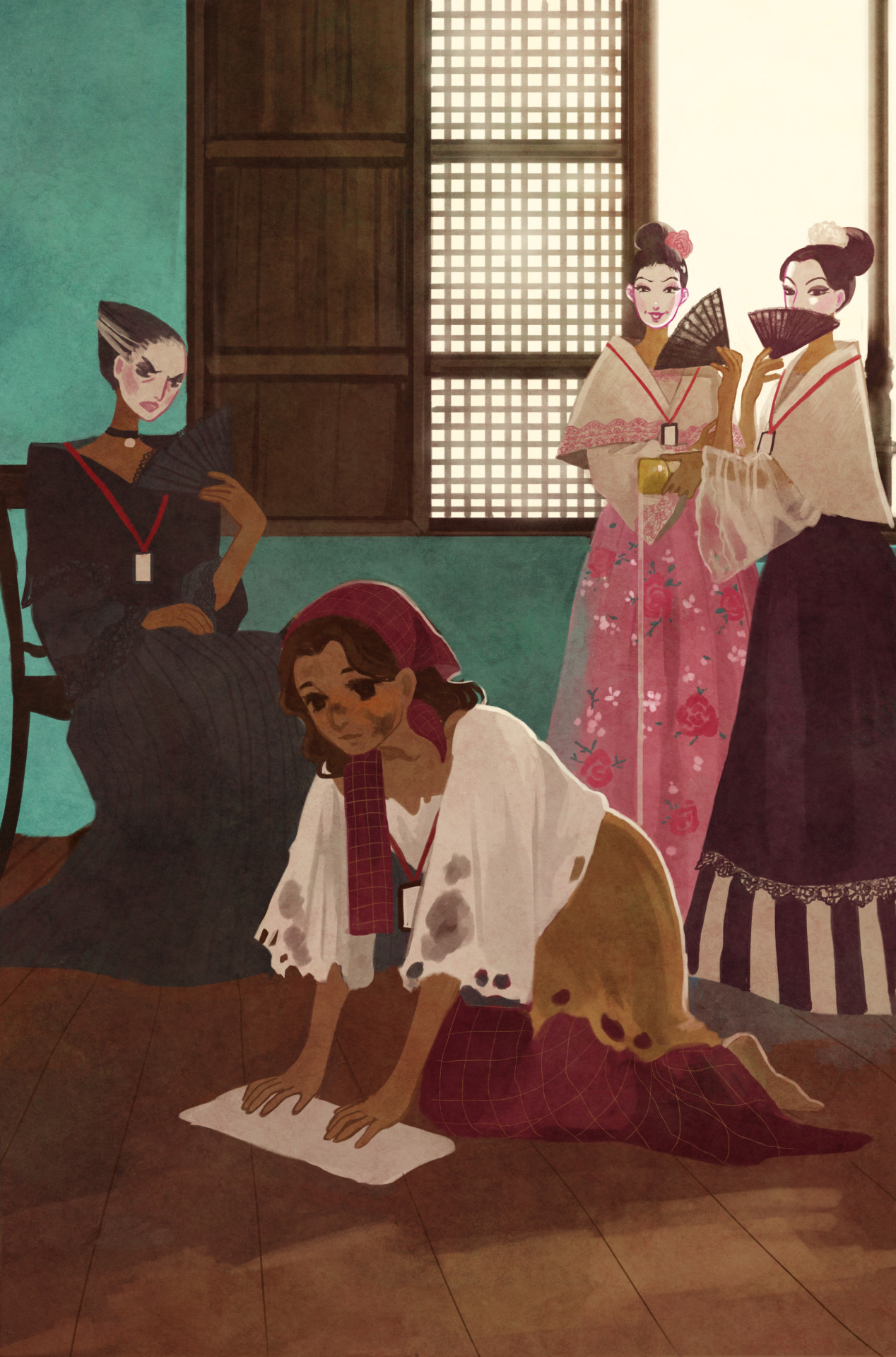
Fairy Tale Friday--Maria and the Golden Slipper (Philippines, 1921)


Hello and welcome to Fairy Tale Friday. Are you sitting comfortably? Good. Then I’ll begin.

This week we look at a tale from the Philippines. It was collected by folklorist Dean S. Fansler who worked at Columbia University in the early 20th century and in 1908 he began working at the University of the Phillippines. From 1908 to 1914, he collected Filipino folklore and eventually published Filipino Popular Tales in 1921.  He was considered a “noted folklorist” for helping to preserve Filipino folklore culture after centuries of Spanish and American domination.


Fansler credits the source for this tale as: "Narrated by Dolores Zafra, a Tagalog from Pagsanjan, Laguna. She says that this is a Tagalog story and was told to her when she was a little girl."


There are several things that I like and dislike about this tale. One of the first things that struck me was the fact that it said A few years later Maria's father fell in love with a widow named Juana, who had two daughters. Every one of these tales has her mother dying and her father remarrying, but this is the first that mentions him actually falling in love with the stepmother. The stepmother is later referred to an Aunt and I don’t know if this means she was a blood relative of her mother’s or simply a polite title used for a stepmother in the Philippines.  The father allows the stepmother and stepdaughters to mistreat her, but it doesn’t say how he feels about them doing so. In fact, after their marriage he is never mentioned by name again.

One of things I don’t like is that the Prince who is hosting the ball plans to choose his bride by her looks. The story says he plans to choose the most beautiful of all to be his wife. I suppose this is true in many of the other tales, but they don’t say it quite so explicitly.

As in the version of Ye Shen, her mother is reincarnated into the magical helper. In Ye Shen is a golden fish, in this tale her mother is a crab. As in many of the other tales, the magical helper is killed and eaten and the bones (in this case the shell) continue to help our heroine after death. Like similar versions, the bones/shell are planted and become a wishing tree that provides the girl with the tools she needs to be presentable at the ball.

It ends, as you would expect, with the lost golden slipper fitting our protagonist. But it also ends with this: So Maria became the wife of the prince, and from that time on she was very dear to her sisters and aunt.

Yeah, I bet she was. It doesn’t say what Maria thought about them suddenly being so fond of her. I know how I would have reacted, but I suspect Maria is as sweet and she is beautiful and embraced them as family.
source

Maria and the Golden Slipper source

Once there lived a couple who had an only daughter, Maria. When Maria was a little girl, her mother died. A few years later Maria's father fell in love with a widow named Juana, who had two daughters. The elder of these daughters was Rosa, and the younger was Damiana. When Maria was grown to be a young woman, her father married the woman Juana. Maria continued to live with her father and stepmother. But Juana and her two daughters treated Maria as a servant. She had to do all the work in the house: cook the food, wash the clothes, clean the floors. The only clothes she herself had to wear were ragged and dirty.

One day Prince Malecadel wanted to get married, so he gave a ball, to which he invited all the ladies in his kingdom. He said that the most beautiful of all was to be his wife.

When Damiana and Rosa knew that all the ladies were invited, they began to discuss what clothes they would wear to the ball; but poor Maria was in the river, washing the clothes. Maria was very sad and was weeping, for she had no clothes at all in which she could appear at the prince's fête.

While she was washing, a crab approached her, and said, "Why are you crying, Maria? Tell me the reason, for I am your mother."

Then Maria said to the crab, "I am treated by my aunt (sic!) and sisters as a servant; and there will be a ball tonight, but I have no clothes to wear."

While she was talking to the crab, Juana came up. The stepmother was very angry with Maria and ordered her to catch the crab and cook it for their dinner. Maria seized the crab and carried it to the house. At first she did not want to cook it, for she knew that it was her mother; but Juana whipped her so hard, that at last she was forced to obey.

Before it was put in the earthen pot to be cooked, the crab said to Maria, "Maria, don't eat my flesh, but collect all my shell after I am eaten, and bury the pieces in the garden near the house. They will grow into a tree, and you can have what you want if you will only ask the tree for it."

After her parents had eaten the flesh of the crab, Maria collected all its shell and buried it in the garden. At twilight she saw a tree standing on the very spot where she had buried the shell.

When night came, Rosa and Damiana went to the ball, and Juana retired for the night as soon as her daughters were gone. When Maria saw that her aunt was sleeping, she went into the garden and asked the tree for what she wanted. The tree changed her clothes into very beautiful ones and furnished her with a fine coach drawn by four fine horses, and a pair of golden slippers.

Before she left, the tree said to her, "You must be in your house before twelve o'clock. If you are not, your clothes will be changed into ragged, dirty ones again, and your coach will disappear."

After promising to remember the warning of the tree, Maria went to the ball, where she was received by the prince very graciously. All the ladies were astonished when they saw her; she was the most beautiful of all. Then she sat between her two sisters, but neither Rosa nor Damiana recognized her. 

The prince danced with her all the time. When Maria saw that it was half-past eleven, she bade farewell to the prince and all the ladies present and went home. When she reached the garden, the tree changed her beautiful clothes back into her old ones, and the coach disappeared. Then she went to bed and to sleep. When her sisters came home, they told her of everything that had happened at the ball.

The next night the prince gave another ball. After Rosa and Damiana had dressed themselves in their best clothes and gone, Maria again went to the garden to ask for beautiful clothes. This time she was given a coach drawn by five horses, and again the tree warned her to return before twelve. The prince was delighted to see her and danced with her the whole evening. Maria was so enchanted that she forgot to notice the time. While she was dancing, she heard the clock striking twelve. She ran as fast as she could down stairs and out the palace door but in her haste, she dropped one of her golden slippers. This night she had to walk home, and in her old ragged clothes, too. One of her golden slippers she had with her; but the other, which she had dropped at the door, was found by one of the guards, who gave it to the prince. The guard said that the slipper had been lost by the beautiful lady who ran out of the palace when the clock was striking twelve.

Then the prince said to all the people present, "The lady whom this slipper fits is to be my wife."

The next morning the prince ordered one of his guards to carry the slipper to every house in the city to see if its owner could be found. The first house visited was the one in which Maria lived. Rosa tried to put the slipper on her foot, but her foot was much too big. Then Damiana put it on her foot, but her foot was too small. The two sisters tried and tried again to make the slipper fit, but in vain.

Then Maria told them that she would try and see if the slipper would fit her foot; but her sisters said to her, "Your feet are very dirty. This golden slipper will not go on your foot, for your feet are larger than ours." And they laughed at her.

But the guard who had brought the slipper said, "Let her try. It is the prince's order that all shall try."
So he gave it to Maria. Then Maria put it on, and it fitted her foot exactly. She then drew the other slipper from underneath her dress and put it on her other foot. When the two sisters saw the two slippers on Maria's feet, they almost fainted with astonishment.

So Maria became the wife of the prince, and from that time on she was very dear to her sisters and aunt.

That’s all for this week. Stay tuned next week for a tale with a Green Knight.

Wednesday, 10 April 2019

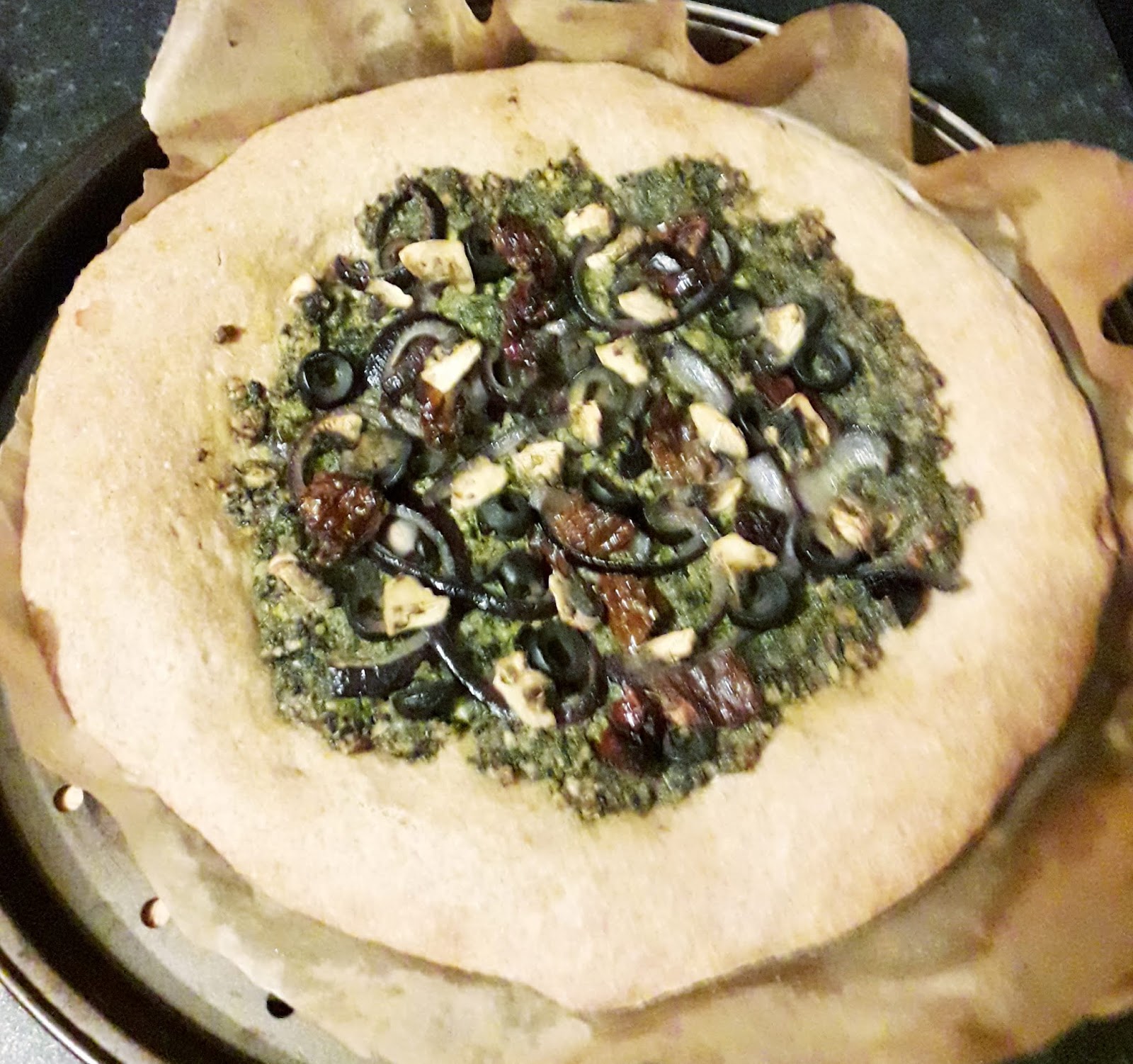
What we Ate Wednesday--Pesto Pizza With Sun-Dried Tomatoes, Olives and Mushroom Feta

Hello lovelies. Still carrying on my hot and steamy love affair with pesto. Oh pesto--you are my besto.

We've had this pizza twice and both times it was gorgeous. Once it was with the wild garlic and walnut pesto and once with spinach and walnut pesto (with extra garlic) and both were equally good.

You can use whatever pizza crust you want--a shop-bought (GF) one or a homemade one. It's really easy to make your own. Always make a double batch and freeze one crust to make future cooking easy.  That is my motto. 

This pizza had a huge wow factor of umami taste (the fifth taste of pungent that completes sweet, salty, sour and bitter) and was super simple to make if you have the pesto ready made (stock up your freezer!) but is still easy if you have to make it on the spot.

I always serve pizza with sauteed kale and whatever toppings didn't fit on the pizza, get thrown in with the kale.

Pesto Pizza With Sun-Dried Tomatoes, Olives and Mushroom Feta

Cook your pizza according to package directions. My pizza cooks at 250C/500F. You cook the crust for 5 minutes and then add toppings then back in the oven for 12 minutes. But do however your pizza crust says to.

Toppings:
Make your PESTO
Caramelised red onion
While your oven is preheating, cook a thinly sliced red onion with a splash of balsamic vinegar and a pinch of sugar until caramelised.
Mushroom feta
4 button mushrooms, diced small
2 TB lemon juice
2 TB apple cider vinegar
1.5 TB nutritional yeast flakes
1/4 tsp marmite(optional) Tesco yeast extract is GF
1/4 tsp garlic powder
1 tsp flaked sea salt
1 tsp oregano
Marinate mushroom while your oven preheats, then carefully take them out with a slotted spoon and put them on the pizza. the sauce can be used on your kale or as a salad dressing.
Olives
Sun-dried tomatoes, snipped into pieces

My pesto recipe made about 1 cup. the pizza used about 3/4 cup of pesto. Save back that 1/4 cup and I will tell you what to do with it (besides eat it from the jar.)

1. Spread pesto on your crust. Top with olives, sun-dried tomatoes and mushroom feta. Bake according to package direction. Swoon and eat.

If you haven't just eaten the leftover pesto from the jar then make some homemade hummus and throw that last bit of pesto in there for a delicious extra bonus of pesto lovin'.


Friday, 5 April 2019

Fairy Tale Friday--The Wicked Stepmother (Kashmir, 1893)


 Hello and welcome to Fairy Tale Friday. Are you sitting comfortably? Good. Then I’ll begin.

This week we look at a tale from Kashmir, India that is both similar and very different to versions of Cinderella we have looked at in the past. It was collected by the Reverend James Hinton-Knowles who was a British missionary in the late 1800s. I could find little information about him except that he worked for the Church Missionary Society in Srinagar, Kashmir, where he was the director of Mission’s Boys’ School from 1880-91.  He was married, with at least one daughter. The one thing we do is that he eagerly studied local folklore and published a book of folktales in 1893.  

I found a copy of his Folk-Tales of Kashmir online HERE which shed some light on the Rev Hinton-Knowles. 

He writes in the introduction:

The vocation of a missionary brings one into close and constant “ touch” with the people, from whom, as I glide along in the boat, or walk by the way, or squat in the hut, or teach in the school, I have learnt many things. My primary object in collecting these tales was to obtain some knowledge of Kashmiri, which is purely colloquial language; my secondary object was to ascertain something of the thoughts and ways of the people.

I would ask my readers to be lenient with me. I have sought not so much to present these tales in a purely literary form as to give them in a fair translation, and most of the work was done by lamplight after an ordinary amount of missionary work during the day.

This tale contains magical transformations into animals as we have seen in previous tales. In this tale, the beloved wife is transformed into a goat. When her Brahman husband sees this, he is very sad, and he kept the goat tied up in the yard of his house and tended it very carefully. Years later he remarries and has his second wife in the house and his first wife pinned up in the front yard. Awkward.  

As in other tales the magical animal helper continues to help the child (children in this case) from beyond the grave since the bones were carefully buried.

What sets this apart from other tales we have looked at is that it is not a shoe that is lost, but rather a piece of jewellery. Our beautiful daughter loses her nose ring while washing her face in the stream where (in a plot that reminds me of Andersen’s The Steadfast Tin Soldier) after a series of adventures ends up in the royal household. The King is fascinated by this and issues a proclamation that whoever is missing a nose ring should report to him. Thankfully, he doesn’t insist everyone try it on as that would be most unhygienic. Come to think of it, everyone trying on a slipper is not that hygienic either. It ends, as you would expect, with the King being so fascinated by her  pretty face and nice manner that he married her, and provided amply for the support of her family.

Image result for indian woman nose ring
source
The Wicked Stepmother source

One day a Brahman adjured his wife not to eat anything without him lest she should become a she goat. In reply the Brahman's wife begged him not to eat anything without her, lest he should be changed into a tiger. A long time passed by and neither of them broke their word, until one day the Brahman's wife, while giving food to her children, herself took a little to taste; and her husband was not present. That very moment she was changed into a goat.
When the Brahman came home and saw the she goat running about the house he was intensely grieved, because he knew that it was none other than his own beloved wife. He kept the goat tied up in the yard of his house and tended it very carefully.

In a few years he married again, but this wife was not kind to the children. She at once took a dislike to them and treated them unkindly and gave them little food. Their mother, the she goat, heard their complainings, and noticed that they were getting thin, and therefore called one of them to her secretly, and bade the child tell the others to strike her horns with a stick whenever they were very hungry, and some food would fall down for them. They did so, and instead of getting weaker and thinner, as their stepmother had expected, they became stronger and stronger. She was surprised to see them getting so fat and strong while she was giving them so little food.

In course of time a one-eyed daughter was born to this wicked woman. She loved the girl with all her heart and grudged not any expense or attention that she thought the child required. 

One day, when the girl had grown quite big and could walk and talk well, her mother sent her to play with the other children and ordered her to notice how and whence they obtained anything to eat. The girl promised to do so, and most rigidly stayed by them the whole day, and saw all that happened.

On hearing that the goat supplied her stepchildren with food the woman got very angry and determined to kill the beast as soon as possible. She pretended to be very ill, and sending for the hakim, bribed him to prescribe some goat's flesh for her. The Brahman was very anxious about his wife's state, and although he grieved to have to slay the goat (for he was obliged to kill the goat, not having money to purchase another), yet he did not mind if his wife really recovered. But the little children wept when they heard this, and went to their mother, the she goat, in great distress, and told her everything.

"Do not weep, my darlings," she said. "It is much better for me to die than to live such a life as this. Do not weep. I have no fear concerning you. Food will be provided for you, if you will attend to my instructions. Be sure to gather my bones, and bury them all together in some secret place, and whenever you are very hungry go to that place and ask for food. Food will then be given you."

The poor she goat gave this advice only just in time. Scarcely had it finished these words and the children had departed than the butcher came with a knife and slew it. Its body was cut into pieces and cooked, and the stepmother had the meat, but the stepchildren got the bones. They did with them as they had been directed, and thus got food regularly and in abundance.

Some time after the death of the she goat one morning one of the stepdaughters was washing her face in the stream that ran by the house, when her nose ring unfastened and fell into the water. A fish happened to see it and swallowed it, and this fish was caught by a man and sold to the king's cook for his majesty's dinner. Great was the surprise of the cook when, on opening the fish to clean it, he found the nose ring. He took it to the king, who was so interested in it that he issued a proclamation and set it to every town and village in his dominions, that whosoever had missed a nose ring should apply to him. Within a few days the brother of the girl reported to the king that the nose ring belonged to his sister, who had lost it one day while bathing her face in the river. The king ordered the girl to appear before him and was so fascinated by her pretty face and nice manner that he married her and provided amply for the support of her family.

That’s all for this week. Stay tuned next week for a tale from the Philippines with a crab as the magical helper.

Wednesday, 3 April 2019

What We Ate Wednesday--Pesto Pasta with Roasted Tomatoes

Hello lovelies! It's been several weeks since I posted a What We Ate Wednesday. A lot of things have happened in my life. I had the privilege of spending 4 nights in hospital with a terminally ill friend and then spent several weeks after supporting her husband and planning her funeral. During this time I started a new job. It has been busy and so have relied on tried and true favourite, easy meals instead of trying new recipes.

This was right at the end of things where I  needed something quick and remembered I had some of that WILD GARLIC AND WALNUT PESTO in my freezer. This came together in a snap and was absolutely gorgeous. We will definitely have this again. And again. And again. If I wasn't already married, I would marry pesto (although I am carrying on a torrid love affair with it.)

I plan to fill my freezer full of jars of spinach and walnut pesto (heavy on the garlic) in the near future so I can always have this meal to hand. Just remember if you freeze it, you need to take it out of the freezer and pop it in the fridge overnight or a few hours on the counter should defrost it.

A note about tomatoes: when I plan to eat them raw, I splurge on the really nice sweeter kind, but if I roast them then I buy the cheap and cheerful sort that costs 54p.

Pesto Pasta with Roasted Tomatoes


Move your oven rack to the highest place and turn on your grill or broiler. I set my temperature at 220 degrees C/425F.

1. Make your pesto. Or be like me and have some already made that you defrosted. (see recipe link above)
2. Boil your (GF) pasta. I used 2 cups of dry pasta for 2 people. 

Meanwhile roast your tomatoes:

Punnet cherry tomatoes (250g)
Slice in halves or quarters and drizzle with
1 TB olive oil
2 tsp balsamic vinegar
generous salt and pepper

Arrange cut side up in a roasting pan. 
Roast 15 minutes under the grill until collapsed

3. When your pasta is boiled, drain it in a colander, but save about a half cup of the pasta water. Add your pasta and pesto back in the hot pan and heat on low heat to soften the pesto and warm it up. Add a splash or two of pasta water to thin the pesto and make it cover the pasta. Add a tin of white beans (like haricot beans) (optional, but makes it more filling) and top with roasted tomatoes. 

That is it. It's not even really a recipe. It's just the best thing you have ever tasted.

I cannot believe I never knew how gorgeous pesto was before this. I make mine with less oil than many recipes, but it still tasted fantastic. Next week I will show you a few more pesto recipes because literally it is the only meal I want to eat these days.